
What is Christian Marriage Counseling?
Most people picture one of two things when they hear "Christian marriage counseling." Either a pastor's office with a Bible on the desk, or ordinary couples therapy with a prayer tacked on at the end.
Neither is quite right.
Christian marriage counseling is a clinically recognized form of couples therapy — provided by licensed mental health professionals — that intentionally integrates Christian faith into the therapeutic process. It uses the same research-supported methods you'd find in any high-quality couples work, while treating your faith as a genuine and central part of who you are and how you understand your marriage.
If you're a couple of faith trying to decide whether it's the right fit, here's what it actually is, how it differs from standard couples therapy, and what to look for.
What Makes It "Christian"
The core techniques in Christian marriage counseling overlap heavily with high-quality secular couples work. The research on what actually helps couples — approaches like Emotionally Focused Therapy (EFT) and the Gottman Method — doesn't change based on someone's faith tradition. A skilled Christian counselor is a clinician first: trained, licensed, and grounded in evidence-based practice.
What changes is the context and the conversation.
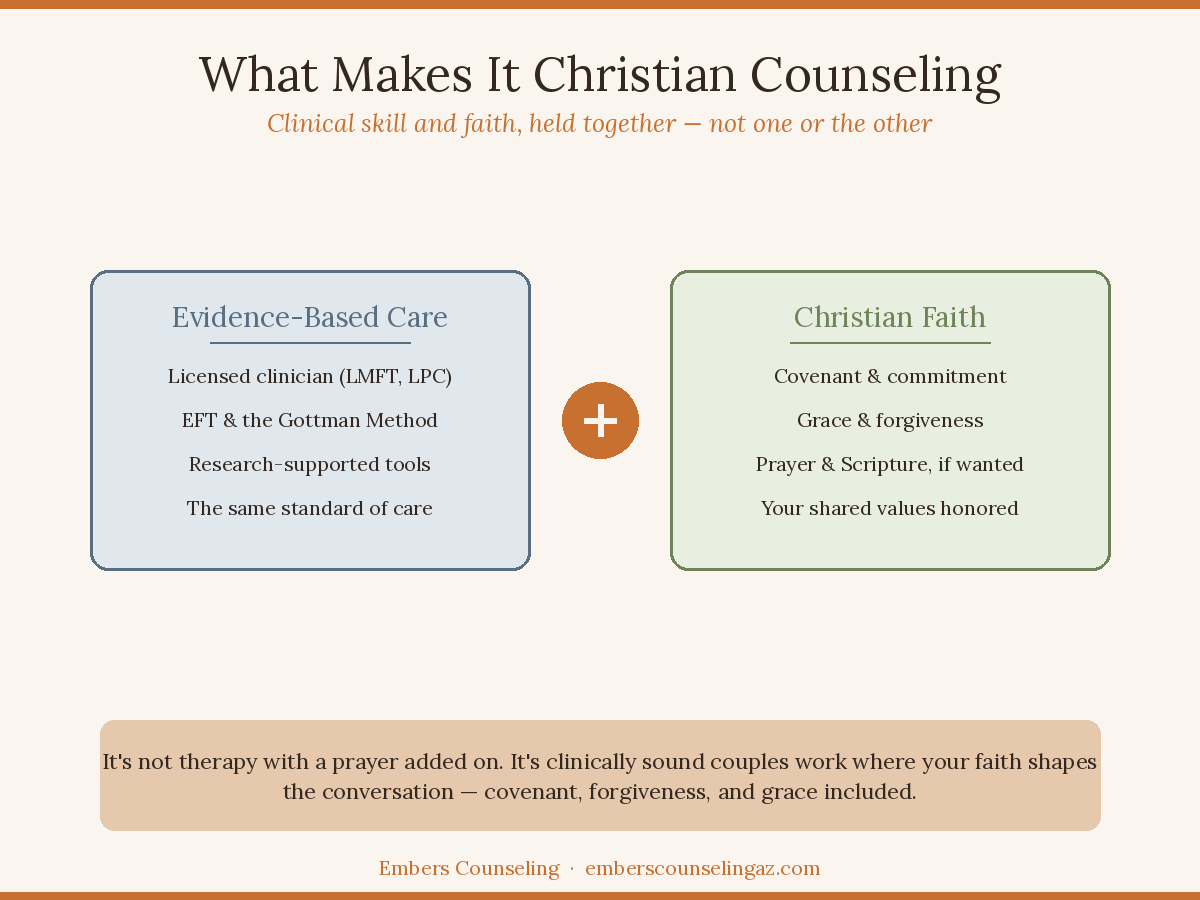
In a Christian setting, the counselor can engage directly with the concepts that shape how you understand marriage:
What it means to love sacrificially, especially when you don't feel like it
How forgiveness in a relationship connects to — and differs from — theological forgiveness
What it looks like to pursue repair as an act of faith, not merely a practical choice
How spiritual disconnection between partners affects intimacy and trust
The role of prayer, Scripture, and community in a marriage that's struggling
For couples whose faith is central to their lives, being able to have these conversations inside the counseling room — rather than translating everything into secular language — makes a real difference.
It's worth being clear about what this does not mean. It doesn't mean every session is a Bible study. It doesn't mean the counselor replaces clinical skill with spiritual advice. And it doesn't mean you'll be told that faith requires you to stay in a harmful situation. Good Christian counseling holds the clinical and the spiritual together, without sacrificing either.
What the Research Says
A fair question: does bringing faith into the room actually help, or is it just a preference?
The research is encouraging. Studies consistently find that for people who value their faith, spiritually integrated therapy often produces a stronger therapeutic alliance, the trusting working relationship between client and counselor that is itself one of the best predictors of good outcomes.
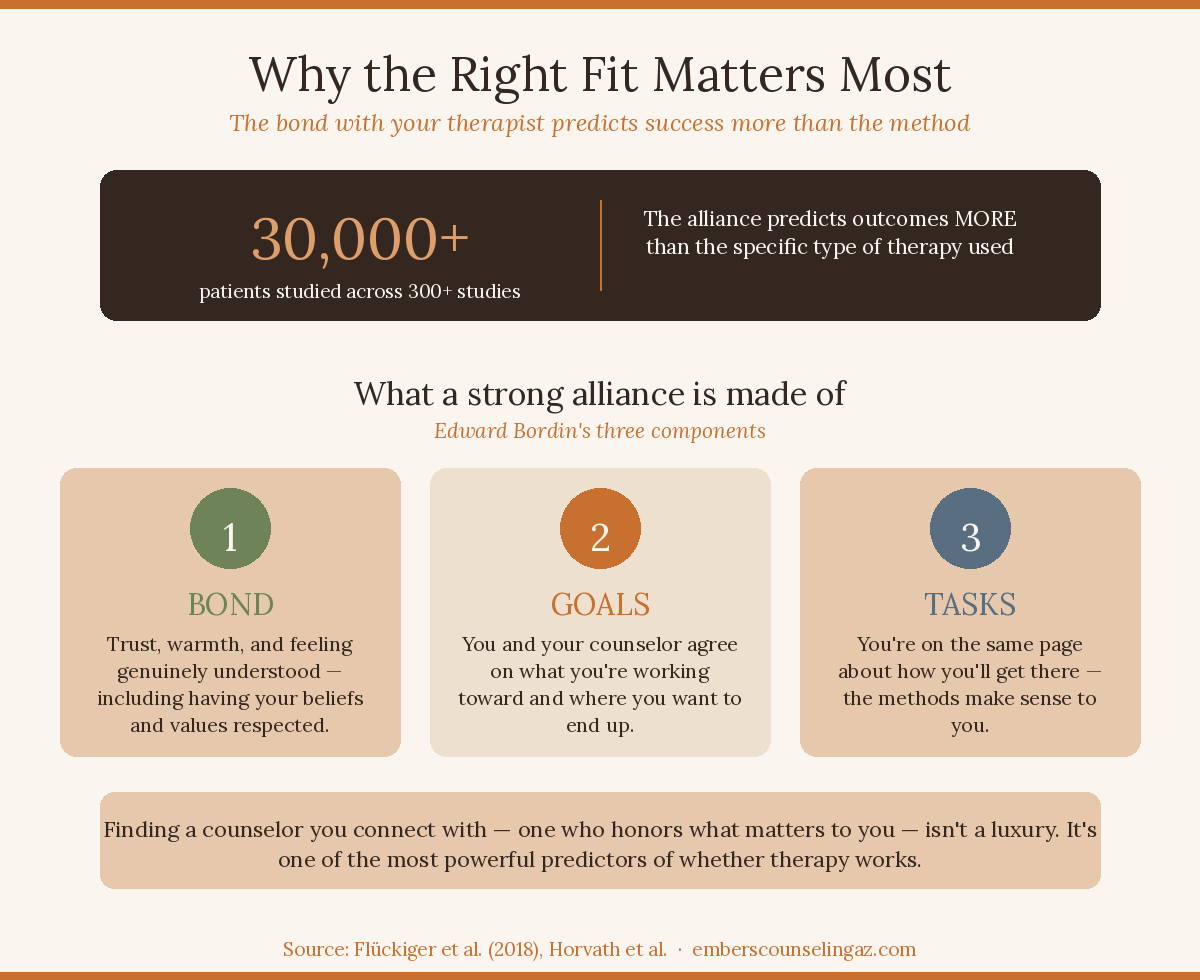
Couples who feel their core values are respected in the room tend to engage more deeply and stay in the process longer. That's not a small thing: engagement and staying power are exactly what couples work requires.
Importantly, faith-integrated therapy doesn't trade effectiveness for values. It achieves outcomes comparable to secular approaches while also supporting the spiritual dimension that matters to the couple. You don't have to choose between clinically sound and faith-honoring care.
How It Differs from Standard Couples Counseling
In a secular setting, a counselor might help a couple articulate what they value without reference to any particular tradition. In a Christian setting, the same underlying work can be framed through a shared spiritual lens.
Consider forgiveness. In any good couples therapy, working through hurt and rebuilding trust is central. In Christian counseling, that process can also draw on a couple's understanding of grace, repentance, and reconciliation — resources that, for a person of faith, carry real weight and meaning.
Or consider commitment. Secular therapy supports a couple's commitment to each other. Christian counseling can additionally engage a couple's understanding of covenant — the sense that their marriage is a promise made before God, not only to one another. For many Christian couples, that framing changes how they approach the hard work of staying and repairing.
The clinical destination is often similar. The path there speaks your language.
Who It's For
Christian marriage counseling is a good fit for couples who:
Share a Christian faith and want it to be part of the counseling process
Come from different faith backgrounds and want to navigate those differences thoughtfully
Have strong faith but feel unsure whether to bring it into a counseling setting
Want a counselor who won't treat their beliefs as a problem to work around
It's worth noting that "Christian" covers a wide range of involvement. You don't have to attend church regularly or hold a particular theological position. It simply means your faith is welcome in the room, however you practice it.
What to Look For in a Christian Couples Counselor
Not everyone who uses the label has the same training or approach. A few things worth asking about:
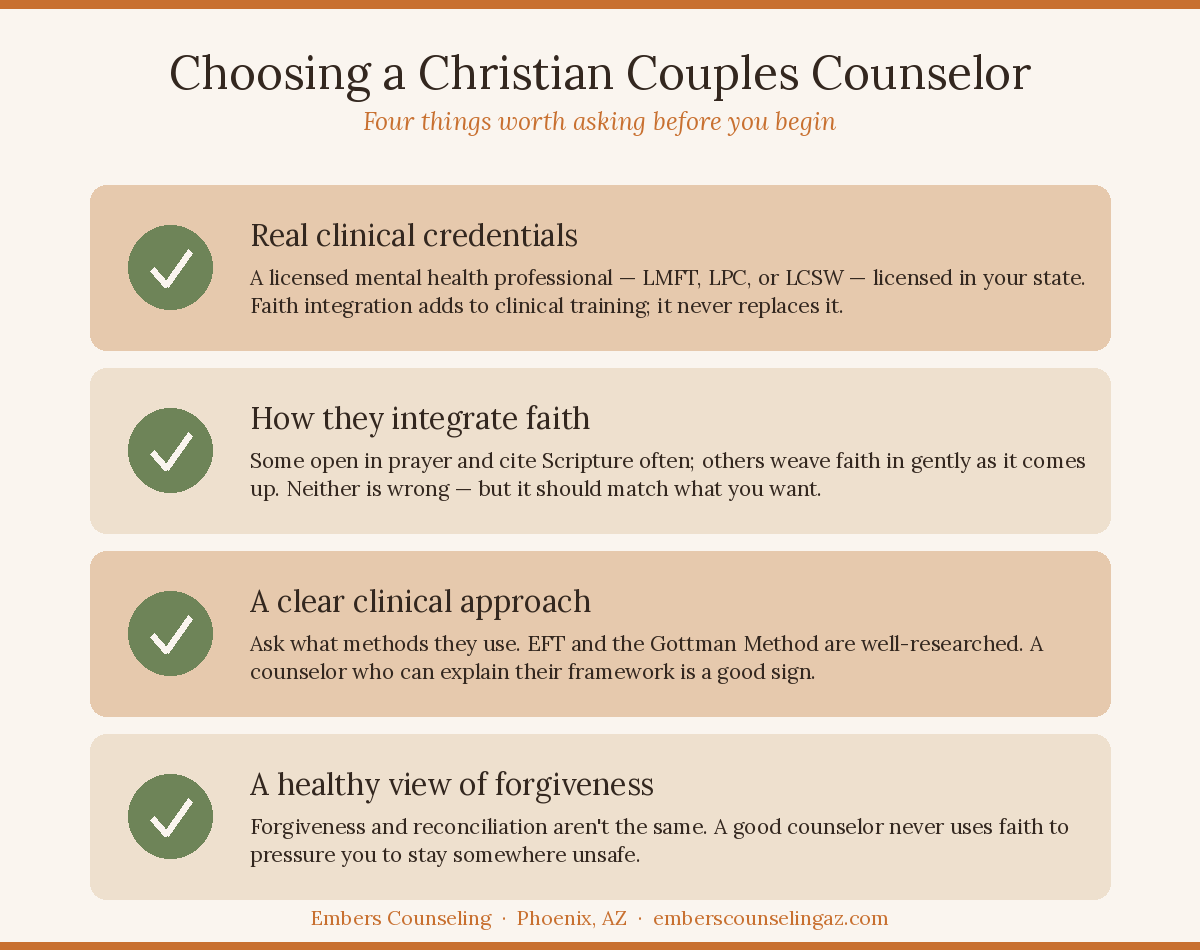
Clinical credentials. A Christian counselor should hold a graduate degree in a mental health field — Licensed Marriage and Family Therapist (LMFT), Licensed Professional Counselor (LPC), or Licensed Clinical Social Worker (LCSW) — and be licensed in your state. Faith integration is an addition to clinical competence, not a substitute for it.
How faith is integrated. Ask how the counselor brings faith into the work. Some are very explicit — opening in prayer, referencing Scripture regularly. Others take a gentler approach, integrating faith as it naturally comes up. Neither is wrong, but the style should match your preference.
Their clinical approach. Ask what methods they use. EFT and the Gottman Method are both well-researched and widely used. A counselor who can clearly describe their framework is a good sign.
Their view of forgiveness and safety. This one matters. A good Christian counselor understands that forgiveness and reconciliation are not the same thing — that forgiveness can be extended by one person, while reconciliation requires genuine change from both. They will never use faith as pressure to remain in an abusive or unsafe situation. If a counselor seems to equate "Christian" with "stay no matter what," that's a red flag.
A Word on Faith and Difficult Situations
Some Christian couples come to counseling carrying a belief that the faithful thing to do is always to keep the marriage together, no matter what. This deserves careful, compassionate attention.
Forgiveness is a gift one person can extend. Reconciliation is a rebuilding that requires both. A skilled Christian counselor can help you think through what your faith actually calls you to in your specific situation — holding the theological and the clinical dimensions at once — without weaponizing Scripture to keep you somewhere harmful. Faith, rightly understood, is never a reason to remain in danger.
Christian Marriage Counseling at Embers
At Embers Counseling in Phoenix, we offer Christian marriage counseling for couples who want their faith to be part of the process. We use evidence-based approaches to couples work — drawing primarily from EFT and the Gottman Method — and we're comfortable speaking in the language of covenant, forgiveness, and spiritual growth when that's what's meaningful to you.
We're also happy to work with couples who simply want a faith-friendly counselor rather than an explicitly faith-centered process. Wherever you land on that spectrum, your beliefs will be respected here.
If you've hesitated about counseling because you weren't sure your faith would be honored — it will be. We'd be glad to talk with you about what that looks like in practice.
This post is educational and not a substitute for professional care. If you and your spouse are navigating a difficult season, a licensed couples counselor can help.