
It's one of the first questions that surfaces after an affair comes to light: Can we actually come back from this?
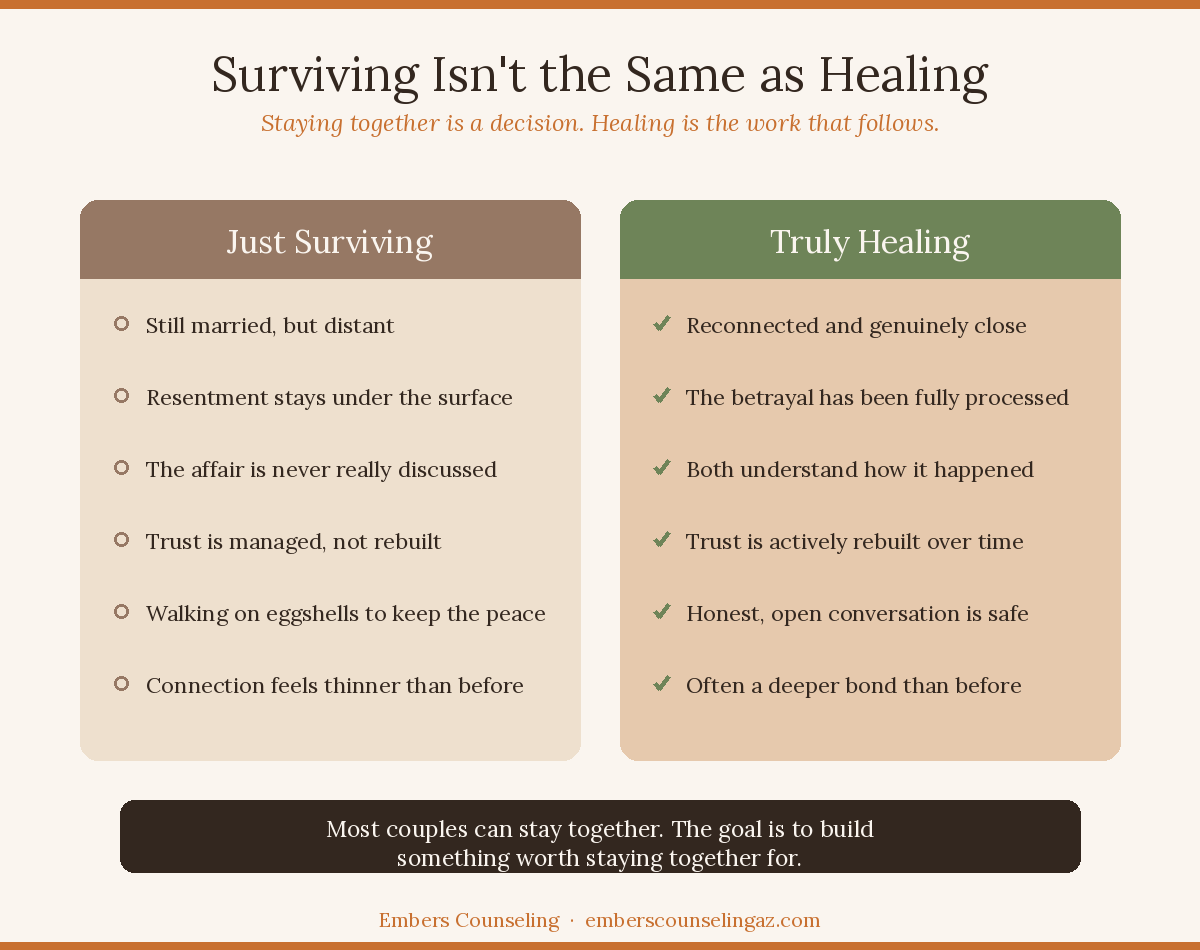
The honest answer is yes — many couples do. But "surviving" and "healing" are two different things, and the difference matters enormously. Some couples stay together and remain stuck: still married, but distant, resentful, never quite whole again. Others do the harder work and come out the other side with a relationship that's genuinely stronger than what they had before.
This post is about what the research actually shows, what separates the couples who heal from the ones who merely endure, and what the path forward looks like.
What the Research Actually Says
If you've been searching for statistics, you've probably found a confusing range of numbers. Here's how to make sense of them.
Most studies find that somewhere between 60% and 75% of couples stay together after an affair is discovered. That's a hopeful figure on its face — infidelity is clearly not the automatic end of a marriage many people assume it to be.
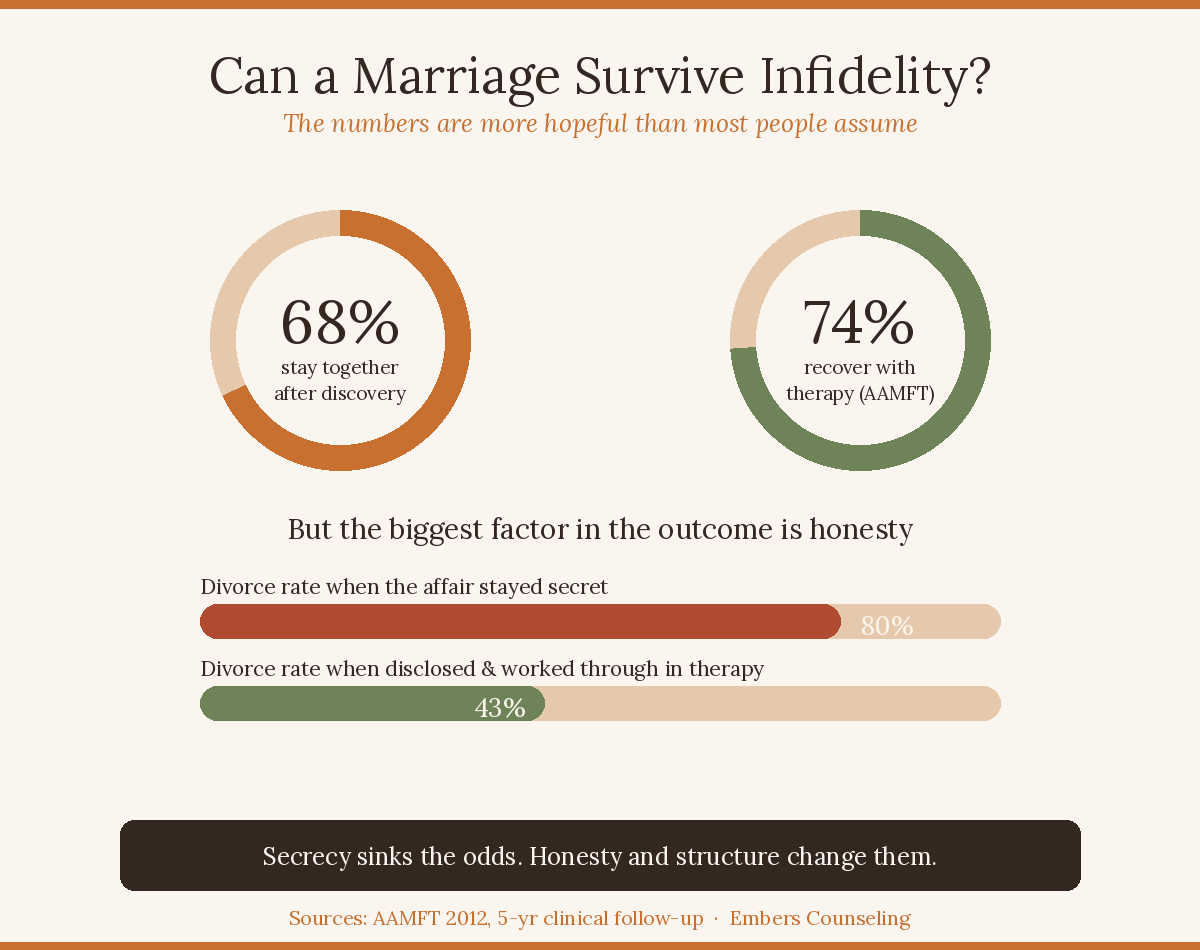
But "staying together" isn't the same as thriving. When researchers use a stricter definition — restored trust, renewed intimacy, genuine satisfaction — the picture is more sobering. And one factor predicts outcomes more powerfully than almost any other: honesty.
In one five-year clinical follow-up, couples where the affair stayed secret had roughly an 80% divorce rate. When the affair was disclosed and worked through in therapy, that dropped to around 43% — close to the rate for couples with no infidelity at all. Secrecy devastates the odds. Structured, honest work dramatically improves them.
The single most encouraging finding for couples willing to do the work: a 2012 survey by the American Association for Marriage and Family Therapy found that 74% of couples who pursued therapy after infidelity were able to recover and rebuild their relationship. Professional support doesn't guarantee an outcome, but it changes the odds substantially.
What Separates Couples Who Heal from Couples Who Just Survive
Recovery isn't random, and it isn't only about how much the couple loves each other. Certain conditions consistently distinguish couples who genuinely heal.
The betraying partner takes full accountability.
Recovery cannot begin while the person who had the affair minimizes, deflects, or blames the relationship. Full honesty — including answering painful questions — is the foundation everything else is built on.
The affair has ended completely.
No contact, no "friendship," no lingering ambiguity. As long as any connection continues, the betrayed partner cannot begin to heal, and trust cannot be rebuilt.
Both partners genuinely want to try.
Sometimes one person stays out of fear, obligation, or shock rather than real desire to repair the relationship. Counseling can help clarify this, but it can't manufacture motivation that isn't there.
There's willingness to look underneath.
Recovering from infidelity is rarely just about the affair. It almost always surfaces patterns — disconnection, unmet needs, communication breakdowns — that existed beforehand. Couples willing to examine those deeper dynamics tend to end up in a far stronger place.
What Recovery Actually Looks Like: The Three Phases
There's a common misconception that recovery means "getting back to normal." It doesn't. After a significant betrayal, the old relationship no longer exists. Recovery means building something new — a relationship that has processed what happened, understands how it happened, and is structured differently going forward.
The most effective affair recovery draws on two complementary frameworks. Dr. John Gottman's Trust Revival Method gives couples the practical, concrete steps — what to actually do at each stage. Emotionally Focused Therapy (EFT), developed by Dr. Sue Johnson, explains what's happening underneath — it treats an affair not just as a rule broken but as an attachment injury, a rupture in the bond that made each partner feel safe. The best work pairs the two: practical action on the surface, attachment repair beneath it.
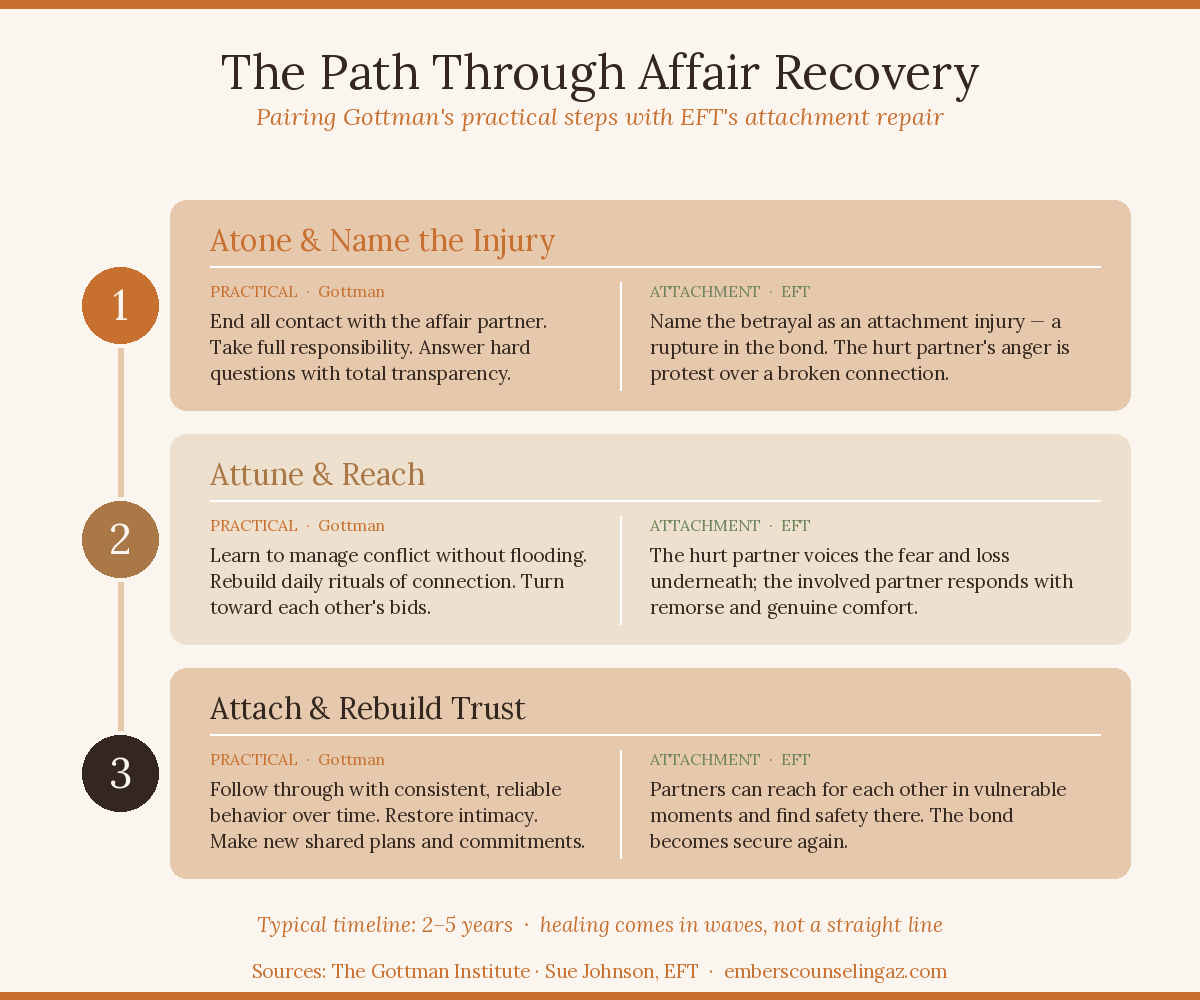
Phase 1: Atone and name the injury.
On the practical level, the betraying partner ends all contact with the affair partner, takes full responsibility, and commits to answering hard questions with complete transparency. Gottman emphasizes that the willingness to be transparent matters even more than the transparency itself. Underneath, this is where the betrayal gets named for what it is in attachment terms — a rupture in the bond. Seen this way, the hurt partner's anger isn't just punishment; it's protest over a broken connection. This phase belongs to their need to grieve, and it's often hardest for the person who had the affair, because the urge to move forward collides with their partner's need to stay with the pain a while longer.
Phase 2: Attune and reach.
Practically, couples learn to manage conflict without being flooded, rebuild everyday rituals of connection, and turn toward each other's small bids instead of away. Beneath the skills, this is the heart of the emotional work: the hurt partner puts words to the fear and loss underneath the anger, and the involved partner learns to take it in and respond with genuine remorse and comfort rather than defensiveness. This is where couples usually begin to glimpse real hope again.
Phase 3: Attach and rebuild trust.
Trust is rebuilt through consistent, reliable behavior over time, and physical and emotional intimacy are gradually restored. In attachment terms, partners become able to reach for each other in vulnerable moments and actually find each other there. The relationship becomes a safe haven again — often a more secure one than existed before — and the affair becomes part of the relationship's history rather than its defining feature.
How Long Does It Take?
Longer than most people want it to. Research and clinical experience consistently point to a recovery timeline of roughly two to five years for genuine healing — the kind where trust is restored and the relationship feels stable again.
That's not a continuous climb. It tends to come in waves. Some weeks feel like real progress; others feel like you've been knocked back to the beginning. Triggers — a date, a place, a song — can reopen the wound unexpectedly, especially in the first year. This is a normal part of the process, not a sign that recovery has failed.
When Recovery Isn't the Right Goal
Not every couple should try to stay together after an affair, and a good counselor will never pressure you in either direction. Recovery is unlikely, and sometimes inadvisable, when:
The betraying partner won't be fully honest or take responsibility
The affair is part of a broader pattern of deception or manipulation
One or both partners have already emotionally left the marriage
There is ongoing abuse of any kind
If you're unsure whether recovery is the right goal, that uncertainty is itself worth exploring — with a counselor who can help you gain clarity without pressure.
The Role of Couples Counseling
Trying to recover from infidelity without professional support is possible, but genuinely difficult. The conversations required are among the most painful two people can have, and without structure they often spiral into cycles that deepen the damage rather than repairing it.
A counselor trained in affair recovery provides a space where the betrayed partner can express grief and anger without the conversation collapsing, a framework for the betraying partner to take accountability without becoming so defensive that nothing lands, and a guide through the phases of recovery so you're not making it up as you go.
At Embers Counseling in Phoenix, affair recovery is one of the core areas we work in. We use a structured, research-based approach that takes both partners seriously — the deep pain of the betrayed, and the genuine desire to repair, when it's there, of the one who strayed.
Where to Start
If you're in the immediate aftermath of discovery, the most important thing is not to make permanent decisions while you're in crisis. Give yourself time to breathe, and reach out for support.
When you're ready to take the next step, we're here. You can contact Embers Counseling to schedule a consultation and talk through what recovery might look like for your specific situation.
This post is educational and not a substitute for professional care. If you're navigating infidelity, working with a qualified couples therapist can make a meaningful difference in your outcome.