
Why You Keep Having the Same Fight (And How to Break the Cycle)
Every couple has a version of it. The argument that has its own script. You both know roughly how it's going to go — who's going to say what, how the other person will respond, how it will end — and yet here you are, running through it again.
Maybe it's about how you spend money. Or whose family gets priority during the holidays. Or how much time one of you spends on work. The specific content almost doesn't matter, because after a while the topic is almost beside the point. The fight itself has become the problem.
So why does this keep happening? And more importantly, can it stop?
The short answer: yes. Recurring conflict is one of the most common reasons couples seek counseling, and it's also one of the most responsive to treatment. But to break the cycle, you first have to understand what's actually driving it — which is almost never the thing you're arguing about.
The Argument Isn't Really About What You're Arguing About
Most recurring relationship arguments aren't really about the dishes or the credit card statement. They're about something underneath — a deeper need, a fear, or a feeling of being unseen that the surface topic is activating.
When you fight about screen time or housework repeatedly, you're usually actually fighting about fairness, or feeling taken for granted, or loneliness, or the fear that your partner doesn't really value you. The topic is just the match that lights the same fire every time.
This is why winning the argument doesn't help. Even when you "solve" the surface issue, the underlying feeling hasn't been addressed — so it surfaces again through the next available topic.
The Cycle: Pursue and Withdraw
Emotionally Focused Therapy (EFT), one of the most well-researched frameworks in couples counseling, describes a dynamic that plays out in the vast majority of recurring relationship conflicts: the pursue-withdraw cycle. Research suggests that roughly 75% of couples get caught in this same pattern, making it the single most common source of disconnection therapists see.
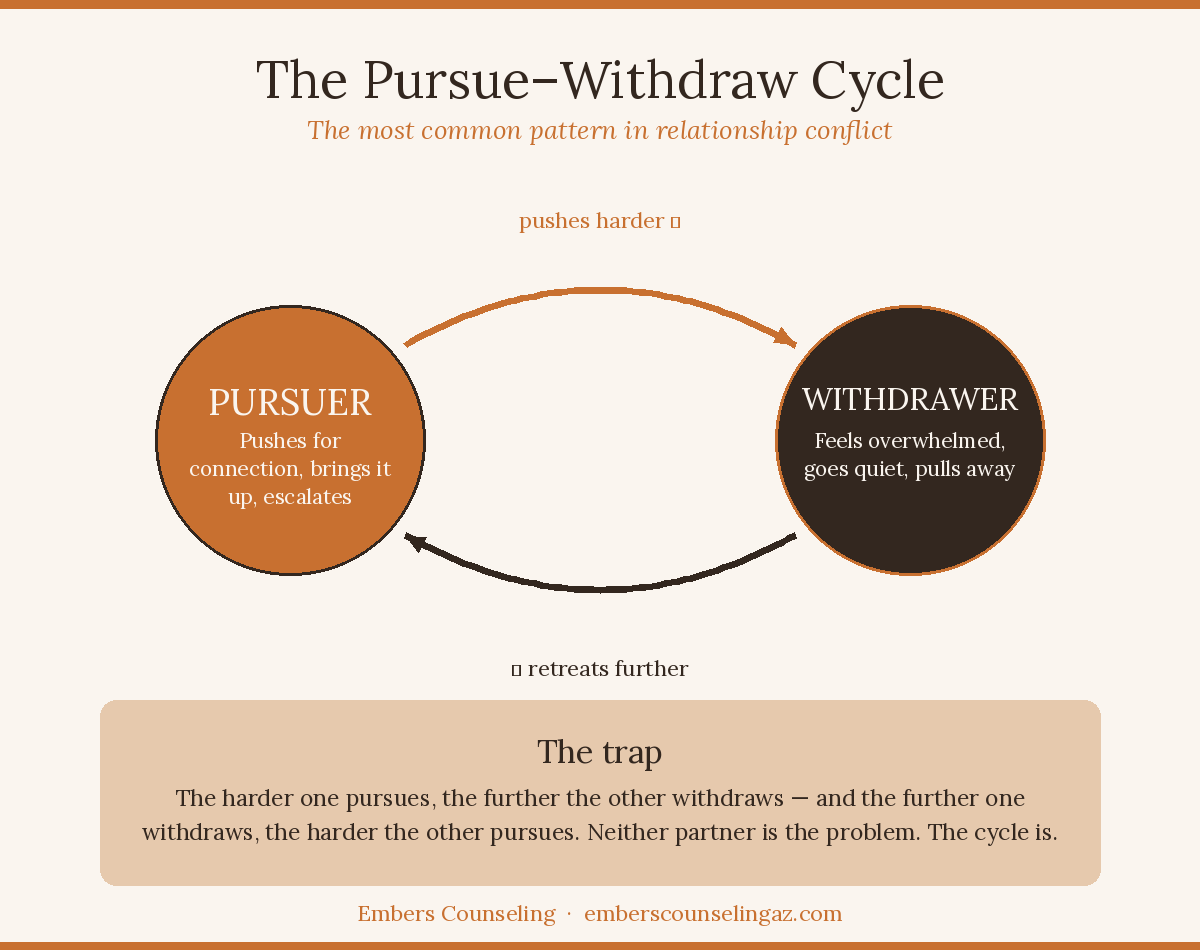
It works like this. One partner — the pursuer — notices disconnection or a problem and tries to close the gap. They bring things up, push for resolution, or escalate emotionally. The other partner — the withdrawer — experiences this as overwhelming or threatening, and pulls back: going quiet, changing the subject, or leaving the room.
The pursuer interprets the withdrawal as confirmation that their partner doesn't care, and pushes harder. The withdrawer experiences the increased pressure as confirmation that engaging is dangerous, and retreats further. Both people are responding to each other in ways that make the other person's worst fears come true.
Here's the crucial part: neither person is the problem, and neither position is wrong. The pursuer isn't "needy" and the withdrawer isn't "cold." Both are protective responses to feeling disconnected. The pursuer protests the distance because the relationship matters. The withdrawer shuts down to avoid making things worse. Both are, in their own way, trying to protect the bond — they've just landed on strategies that collide.
What's Happening in Your Body
Part of why these fights feel impossible to control is that they aren't just psychological — they're physiological.
Dr. John Gottman's research at the University of Washington found that when a person's heart rate climbs above roughly 100 beats per minute during conflict, the body enters a state he called flooding, or diffuse physiological arousal. Adrenaline is released, the fight-or-flight system activates, and the part of the brain responsible for empathy, listening, and careful reasoning starts to go offline.
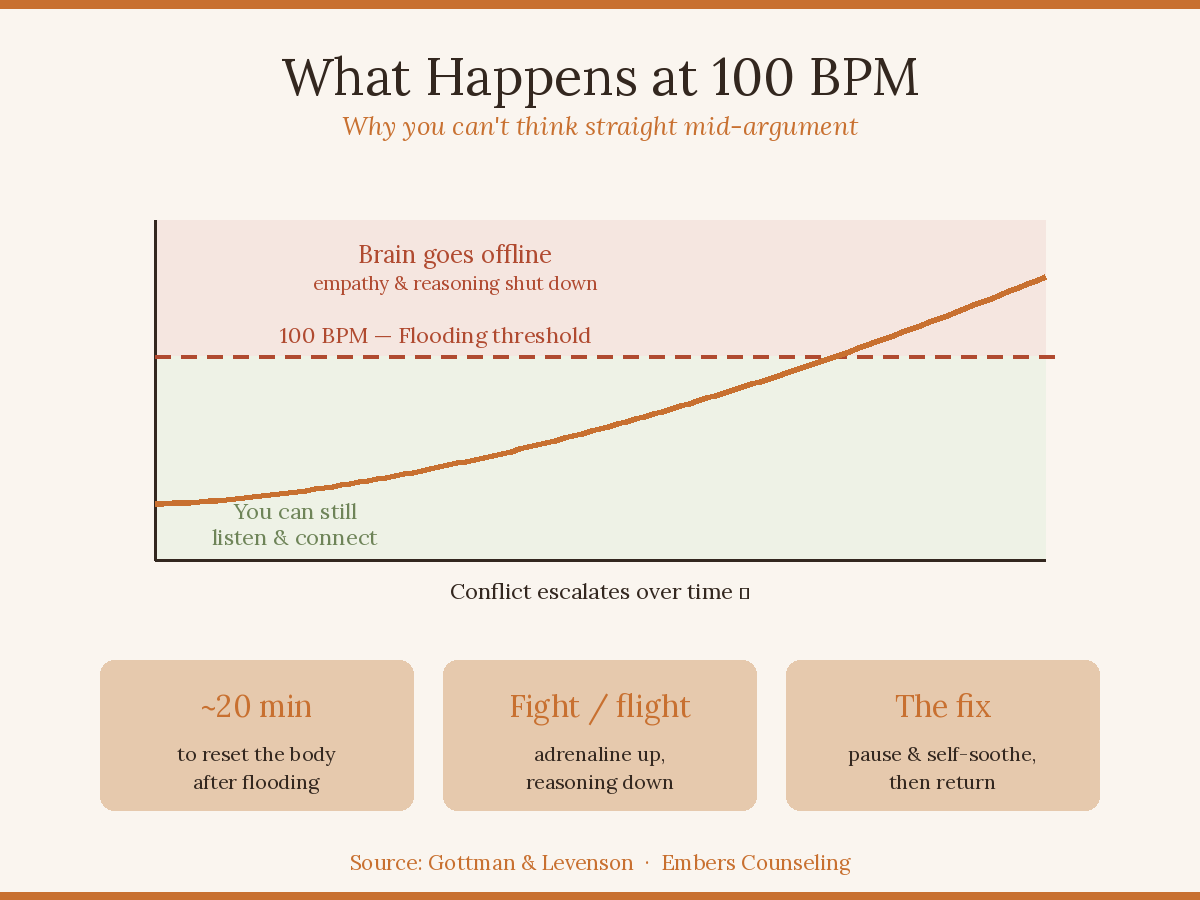
In that state, the content of the conversation almost stops mattering. Your partner isn't hearing your carefully worded point — their nervous system is processing it as a threat. This is why "let's just talk about this rationally" so often makes things worse: you can't apply a rational solution to a body that's in survival mode.
Gottman's research also found that it takes about 20 minutes for the body to return to baseline after flooding — but only if you actually stop and self-soothe, rather than replaying the argument in your head.
What Keeps the Cycle Going
A few things lock the pattern in place:
Escalation. When emotions rise quickly and flooding kicks in, you're no longer trying to solve a problem — you're in self-protection mode. Anything said or heard in that state gets filtered through fear rather than curiosity.
Assumption. After years of the same argument, you stop hearing what your partner actually says and start hearing what you expect them to say. "Here we go again" is the sound of two people talking to the version of each other they've constructed in their heads rather than the person in front of them.
Unspoken bids. What sounds like a complaint is often a bid for connection that hasn't been decoded. "You never want to do anything together" usually means "I miss you and I don't know how to say that without it coming out as an accusation."
How to Actually Break the Pattern
Name the cycle, not each other. Instead of "you always do this," try "we're in that loop again." Externalizing the pattern — treating it as a third thing you're both facing rather than a character flaw in one of you — takes the blame out of it and makes it easier to step back.
Learn to spot flooding early. Notice the physical signs — the tightening chest, the rising voice, the urge to either push harder or bolt. When you feel them, that's the signal to pause, not push. Naming it without blame ("I'm getting flooded, I need twenty minutes") protects the conversation.
Take a real break, then come back. A pause only works if it's long enough for your body to reset — at least 20 minutes — and if you genuinely come back to it. Walking away permanently teaches the pursuer that their fear of abandonment is justified. Coming back teaches both of you that the relationship can hold hard things.
Say what's underneath. This is hard, and it takes practice. But instead of pressing the complaint ("you never listen to me"), try saying the fear or the longing underneath it ("I'm scared we're drifting apart and I don't know how to reach you"). It's vulnerable. It's also much more likely to land.
Get curious instead of certain. When you're sure you know what your partner means, you've stopped listening. "What's going on for you right now?" is disarming in a way that "you're always doing this" is not.
When You Can't Break It Alone
For many couples, the pattern is too entrenched to shift without help. You've tried having the conversation differently and it ends up in the same place. You know intellectually what you're "supposed" to do and you still can't do it in the moment.
This is not a character deficiency. It's just how deeply ingrained patterns work — especially patterns tied to core fears about love, safety, and belonging. The part of you that runs this argument is older and faster than the part that knows better.
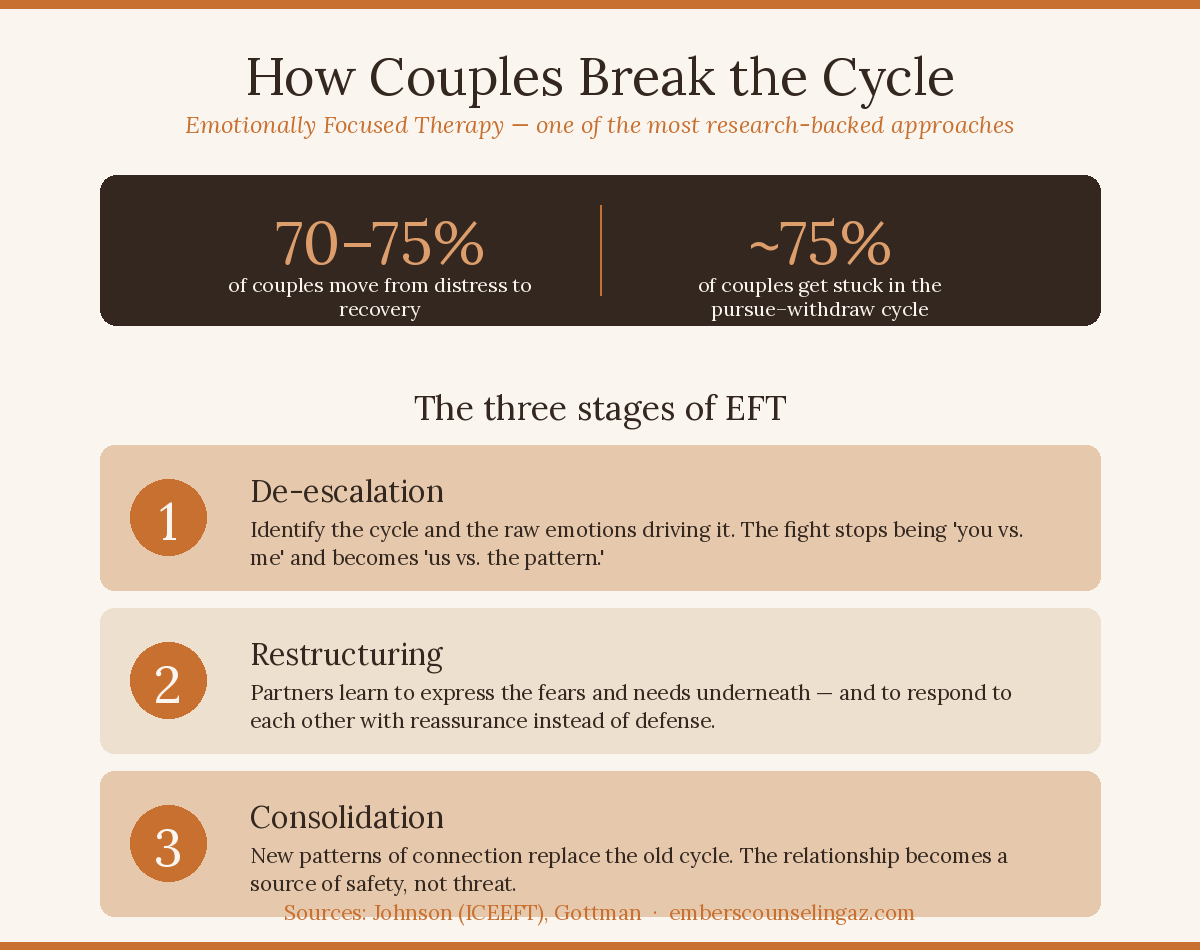
Couples counseling helps because it gives you a structure and a guide in the room while you're actually in it. This is exactly what EFT is designed to do, and the results are strong: research shows that 70–75% of couples move from distress to recovery, and that cycle intensity drops significantly within the first several sessions.
At Embers Counseling in Phoenix, helping couples break recurring conflict cycles is central to the work we do. If the same fight keeps finding you, we'd be glad to help you find a way out of it.
info@emberscounselingaz.com | (602) 341-5177