
You can look forward to your mom’s cooking and feel anxious about the conversation at her table. You can love your in-laws and wish the visit were shorter. You can be grateful to gather and still miss someone so much that celebrating feels complicated.
The holidays have a way of bringing a lot of feelings into the same room.
Between travel, traditions, spending, and family expectations, even a simple invitation can carry more weight than it seems. A little preparation can help you make room for connection while caring for your own needs.
Family stress during the holidays is common
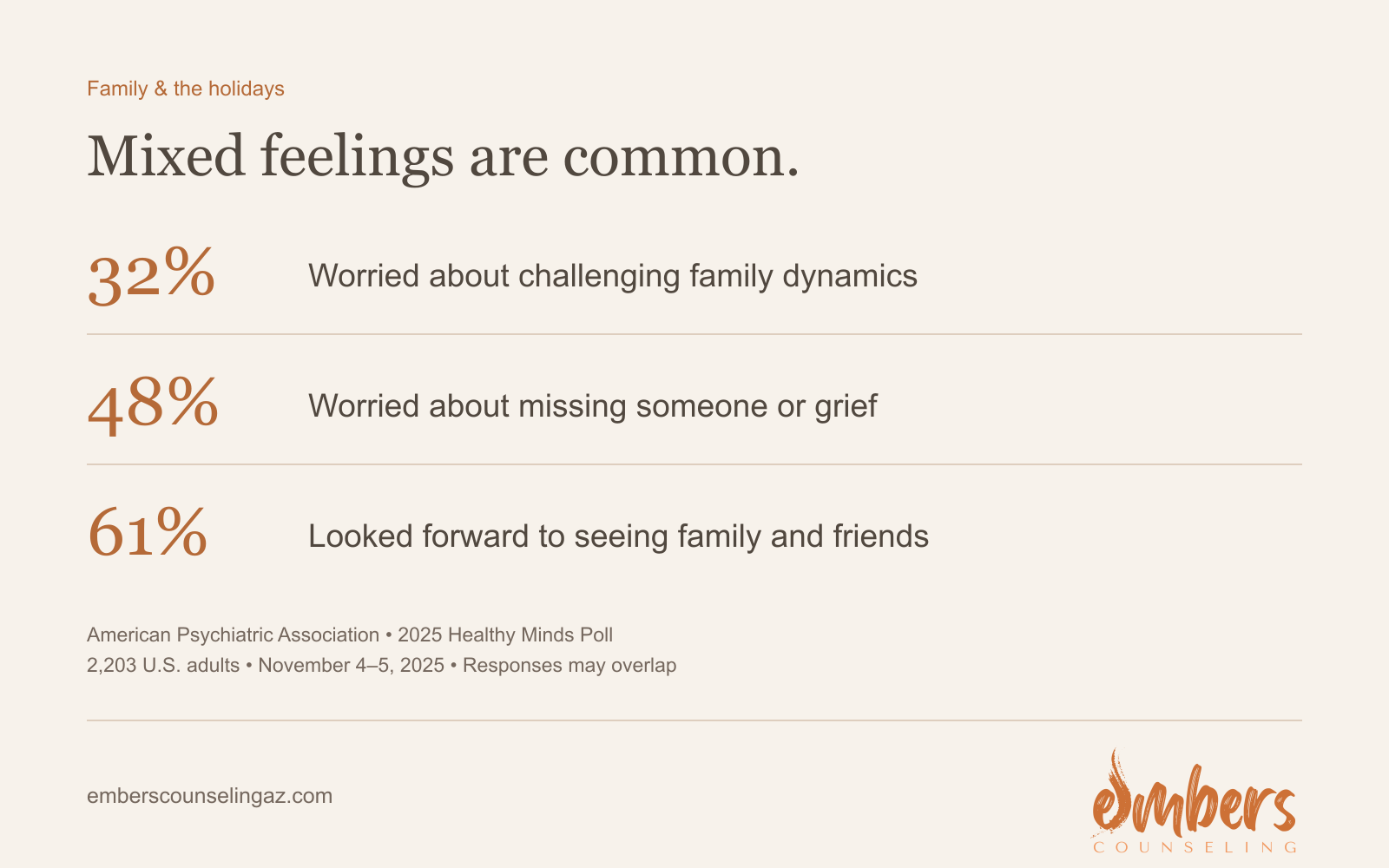
In the American Psychiatric Association’s 2025 Healthy Minds Poll of 2,203 U.S. adults:
32% were worried about dealing with challenging family dynamics.
48% were worried about missing someone or grief.
61% selected seeing family and friends among the things they most looked forward to.
The poll was conducted November 4–5, 2025. These are overlapping responses about concerns and hopes, not a diagnosis of family dysfunction or a breakdown specifically of in-law relationships. Read the poll findings.
Together, the findings leave room for a familiar experience: wanting time with people you love while anticipating that some of it may be difficult.
Why familiar relationships can feel harder this time of year
Holiday plans often carry unspoken meanings. A parent may hear “We’re spending Christmas morning at home” as “You don’t matter to us.” An adult child may hear “You’re leaving already?” as “Whatever I give is never enough.”
Those interpretations may not match what the other person intended. But they can turn a conversation about schedules into a conversation about belonging, loyalty, or being appreciated.
Old roles can also reappear. You might find yourself smoothing over disagreements, organizing every meal, or defending choices you usually feel comfortable making. Add fatigue and a crowded calendar, and there may be less room to respond thoughtfully.
As Mayo Clinic Health System explains, expectations shaped by memories and traditions can become stressful when real circumstances do not match the holiday we imagined. Adjusting expectations is a practical place to start. Read Mayo Clinic’s guidance.
Agree on a plan before answering the invitations
If you are making plans with a partner, talk privately before promising time to either side of the family. Consider travel, finances, children’s needs, work schedules, and your capacity for hosting.
Ask each other:
Which tradition matters most to you this year?
What felt stressful last year that we could change?
How much time, money, and energy can we realistically offer?
What support would help you feel less alone during a difficult visit?
One family might alternate the holiday itself. Another might celebrate with grandparents the following weekend. A blended family may need several smaller celebrations. Different arrangements can still communicate care.
When it feels safe and workable, each partner can take the lead in communicating the shared plan to their own relatives. “We’ve decided to leave at six” presents a joint decision more clearly than blaming a spouse for wanting to go home.
Use boundaries that are warm, specific, and realistic
A boundary describes what you will participate in and what you will do if a limit is crossed. It helps to decide what you can follow through on before the gathering.
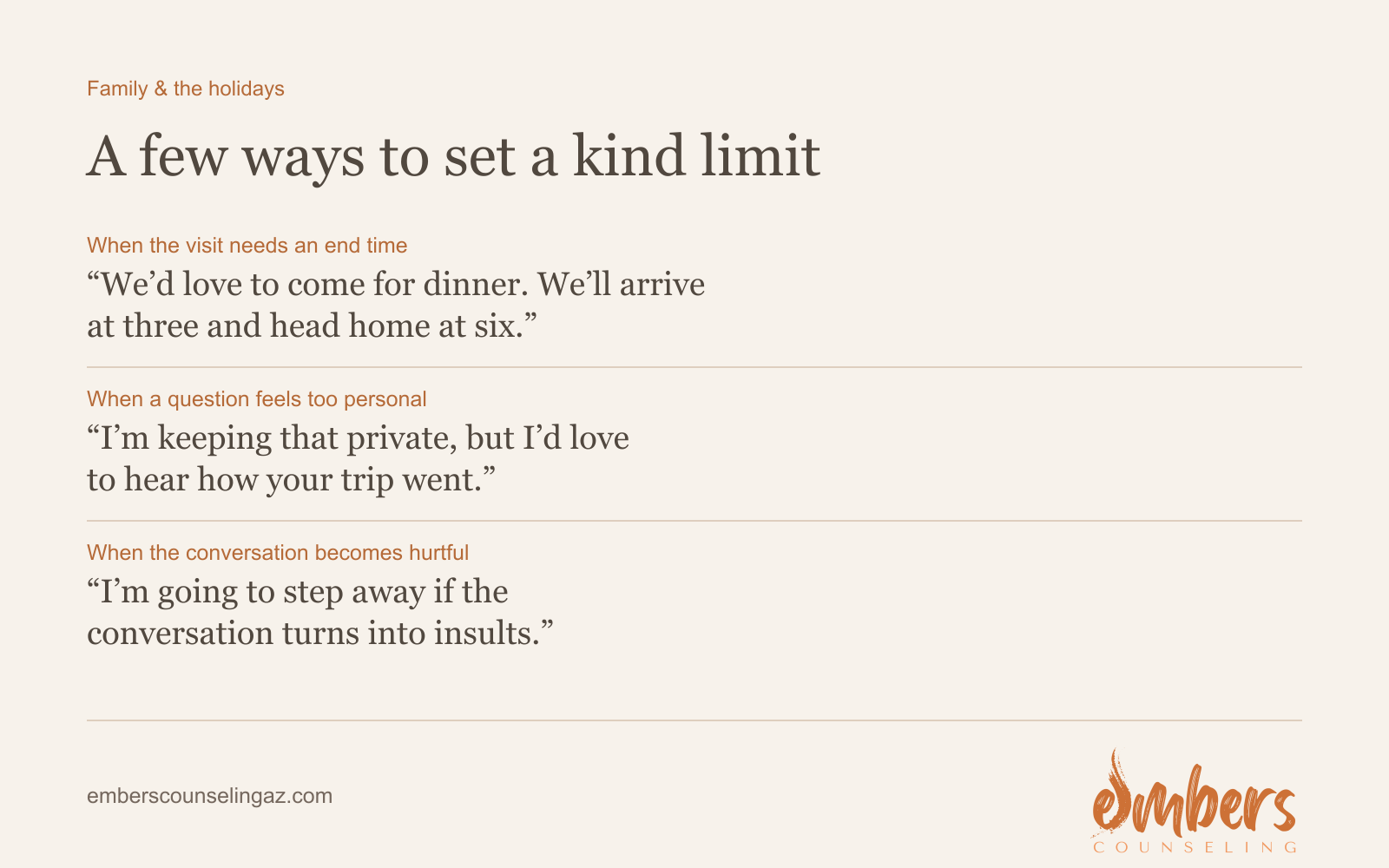
Try language like:
“We’d love to come for dinner. We’ll arrive at three and head home at six.”
“I’m keeping that private, but I’d love to hear how your trip went.”
“I’m going to step away if the conversation turns into insults.”
Someone may feel disappointed even when you communicate kindly. You can acknowledge that feeling without immediately changing the plan: “I know you hoped we could stay longer. We’re looking forward to the time we do have together.”
Mayo Clinic Health System recommends planning ahead, communicating expectations, and allowing yourself to decline events or shorten visits when needed. Explore its holiday-boundaries guidance.
Make a plan for tense moments
Some subjects are easier to discuss privately, with more time and fewer people listening. You can choose to postpone a conversation about politics, parenting, money, or a longstanding disagreement.
If you notice yourself getting tense, try a brief pause: “I want to respond thoughtfully. I’m going to get some air.” You might take a short walk, get water, or check in with a supportive person.
If you spoke sharply, a simple repair can help: “That came out more harshly than I intended. Let me try again.” You can take responsibility for your tone while still keeping your limit.
For parents, this also means keeping children out of adult disagreements. Avoid asking them to choose sides or carry messages between households.
If a gathering involves threats, intimidation, or abuse, prioritize safety. You do not have to attend or remain in an unsafe situation; individual professional support can help you consider your options.
Leave room for grief and changing traditions
An empty chair, a divorce, an estrangement, or a loved one’s declining health can change the meaning of the season. Family members may respond differently. One may want to talk and remember; another may want a quieter day.
Try asking, “What would feel supportive this year?” rather than assuming everyone needs the same celebration.
You might make a favorite recipe, share a memory, shorten a gathering, or create a new tradition. Leave participation optional. No one needs to perform cheerfulness to belong.
If family contact is limited or unavailable, consider making a specific plan with a friend, a trusted community, or someone else whose company feels supportive.
Choose a few things you can actually carry
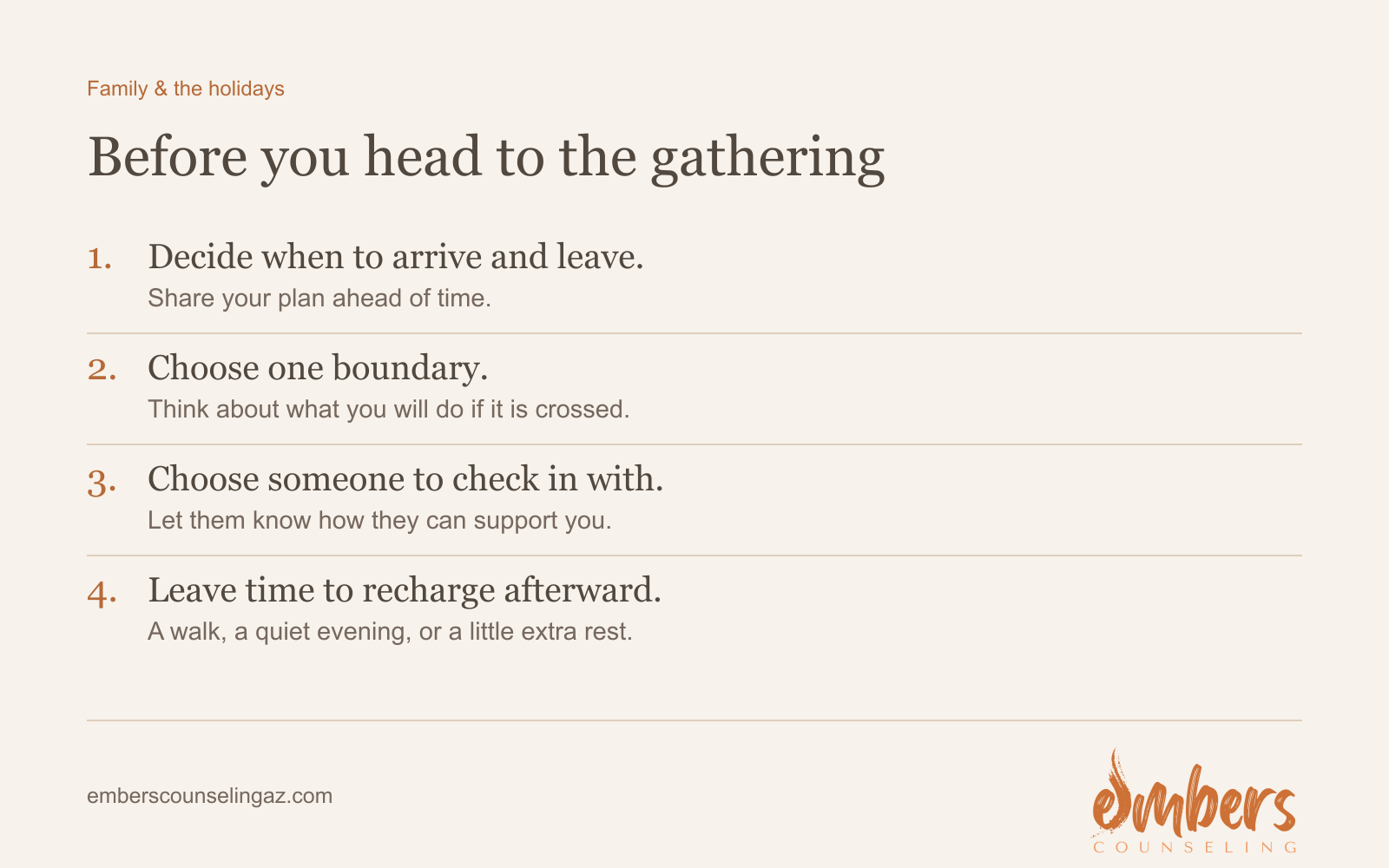
Before your next gathering, write down your arrival and departure times, one boundary, one person you can check in with, and something restorative for afterward.
Give yourself a little space after the visit before evaluating every conversation. Later, ask: “What felt good? What was difficult? What would we change next time?”
Support for the relationships that matter to you
A meaningful holiday can include an awkward moment, a changed tradition, or a kind “no.” There can still be laughter, closeness, and small moments worth keeping.
If family expectations, in-law tension, or recurring arguments are weighing on you, support is available. At Embers Counseling in Phoenix, we help individuals, couples, and families work through relationship difficulties and practice clearer communication.
Explore our family counseling services or connect with us to talk about the next step. We would be glad to walk alongside you.
Embers Counseling
Phoenix, Arizona
(602) 341-5177